
Billy Green
Billy Green
★ NewFlagship System V4.0

Billy Green
Master Control

The Cultivation Operating System

Built from the plant outward.
Engineered from the data model inward.

Live in a cultivation facility today

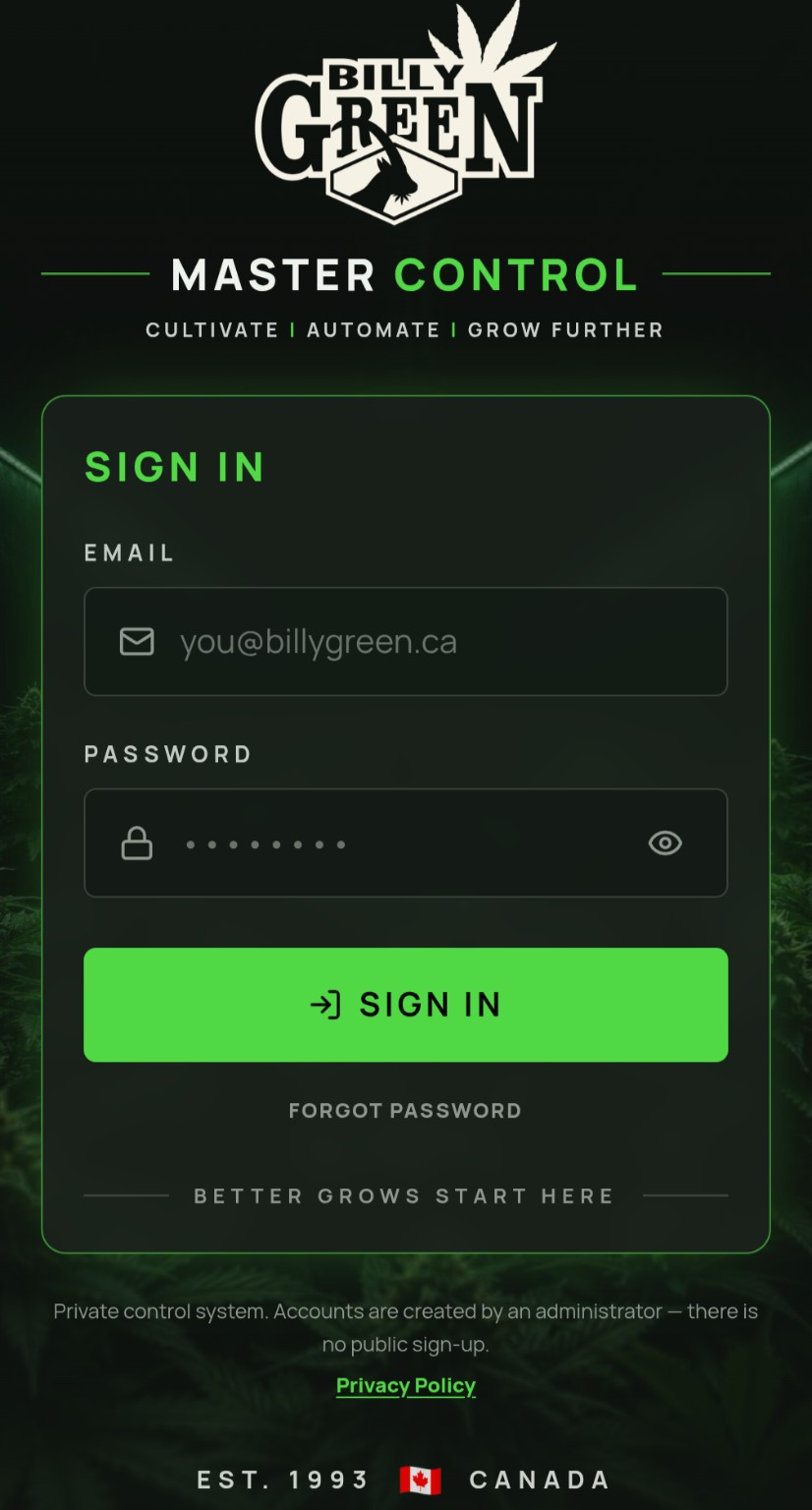
Billy Green Master Control sign-in screen

Operating Principle

Cultivation has never needed more disconnected technology.

It has needed one system capable of understanding what the grower is trying to accomplish - and coordinating the facility around the plant.

01Platform

The Cultivation Operating System

Billy Green Master Control is a grower-built cultivation operating system designed to connect cultivation strategy, plants, genetics, Rooms, spatial Areas, irrigation zones, root-zone response, environment, lighting, CO₂, compatible equipment, people, safeguards and historical performance into one operating model.

It grew out of decades of real cultivation - decades of building a system that worked while being forced to run that system across multiple controllers, multiple apps, handwritten records and spreadsheets because no single platform could preserve the whole cultivation story.

BGMC changes that. The grower defines the strategy. The platform understands where the plants are and what they are. Compatible technology works toward the strategy. Sensors measure the response. BGMC watches the exceptions, preserves the truth of what happened and gives the next crop the benefit of everything learned before it.

  1. 01

    Target›

  2. 02

    Measure›

  3. 03

    Control›

  4. 04

    Verify›

  5. 05

    Alert›

  6. 06

    Learn

This is not a concept waiting for its first crop. Version 1 is operating today in Billy Green's own cultivation facility during an active production run with live irrigation control, environmental monitoring and root-zone sensing.

Remarks from Billy

— Billy Green
“I didn't wake up one day and decide I wanted to build software. I realized I had already spent decades designing a cultivation system. The problem was that my system lived in my head, in my rooms, in half a dozen apps, in notebooks and in spreadsheets. BGMC is me finally putting the whole thing together.”
02Platform

Why BGMC Exists

For decades, Billy Green has cultivated indoors, worked with thousands of cultivars and continually refined the way a room should operate. Irrigation strategy, plant steering, genetics, environment, lighting, CO₂, timing, crop observations and final results were never separate ideas to the grower. They were parts of one crop.

The technology, however, was separate. One controller knew irrigation. Another system knew climate. A sensor platform knew measurements. A spreadsheet knew plant counts. Notes held cultivar observations. The grower had to become the integration layer.

The System Existed Before the Software

BGMC did not begin as a blank software concept. The cultivation workflow existed first. Billy had already spent years deciding what to measure, what to watch, what mattered at each stage, how to compare cultivars, how to diagnose a room and how to carry lessons forward. What did not exist was a practical platform capable of holding all of those relationships together.

That limitation became impossible to ignore when an irrigation controller began dictating what Billy could do instead of following the irrigation strategy he wanted to execute. Opening the irrigation architecture solved the immediate problem, but revealed the larger one: if irrigation could be rebuilt around the grower, why should everything else remain disconnected?

A Founder Who Lives With the Consequences

Billy has always put his own money behind his cultivation decisions. His facilities, equipment and crops were his responsibility. BGMC is therefore being questioned against real cultivation: missed irrigation, uneven rooms, sensor failures, mixed cultivars, changing plant counts, equipment limitations and the need to know exactly what happened after the crop is finished.

Why should the grower adapt to the software?
Why not build the software around the grower?

Remarks from Billy

— Billy Green
“If I make a bad cultivation decision, I don't get to blame the software company, the owner or somebody else's budget. That has always forced me to think hard about why I do something, what I need to measure and whether the result was actually better. That same accountability is being built into BGMC.”
03Platform

Built for the Plant and the Grower - Not to Sell Hardware

Many cultivation technology products naturally begin with the hardware they sell: a sensor, controller, environmental system or equipment ecosystem. BGMC begins somewhere else. It begins with the plant, the grower's strategy and the physical reality of the facility.

BGMC is intended to remain hardware-flexible. A facility should be able to use practical compatible equipment and the number of sensors appropriate to its operation rather than being forced into an expensive proprietary stack simply to participate in the platform.

The Digital Model Follows the Real Facility

  1. 01Facility
  2. 02Room
  3. 03Spatial Area
  4. 04Grow Area / Table
  5. 05Irrigated Section
  6. 06Solenoid
  7. 07Irrigation Zone
  8. 08Plants
  9. 09Cultivar / Lot
  10. 10Crop Run
  11. 11Control Program

Those are not just menu items. They allow BGMC to understand what a measurement or command actually means. A root-zone reading belongs to a physical plant context. An environmental sensor represents a Room or defined Area. A solenoid defines an irrigation reality. A cultivar occupies a known location during a known Crop Run.

It Scales With the Facility

A small craft grower may have a simple room and a small sensor count. A large commercial facility may have many Rooms, Areas, Tables, irrigation zones and sensors. The operating model remains coherent while connected hardware scales with the facility.

Cost-Effective by Design

BGMC is intended to work with practical compatible technology wherever reliable interfaces are available. Facilities can add sensing or control depth where the operational value justifies it instead of replacing every useful piece of equipment.

Remarks from Billy

— Billy Green
“I don't want BGMC to become another reason a grower has to spend a fortune before the software becomes useful. It should become more powerful as you add sensors and integrations, but the architecture should still make sense if your facility is simple. The plant doesn't care what logo is on the sensor.”
04Platform

The Control Program:
The Grower's Strategy Made Executable

The Control Program - the grower's Recipe - is the heart of BGMC. It is not simply a nutrient recipe. It is the approved cultivation strategy for how the crop should be grown through each stage of its lifecycle.

Irrigation

P1/P2/P3 events, shot size, timing windows, dryback and runoff

Root Zone

VWC, substrate/pore EC, temperature and response

Input / Runoff

Input EC/pH, runoff %, runoff EC/pH

Environment

Temperature, RH, VPD and spatial Area response

Light + CO₂

PPFD, CO₂ strategy, stage and intensity

Crop

Cultivar, lot, Plant Age, Stage Day, Room, Table and Crop Run

Accountability

Required checks, exceptions, due actions and responsible roles

One Strategy - Not Isolated Setpoints

Lighting can work toward the approved PPFD target. CO₂ can follow stage and light intensity. HVAC, humidification and dehumidification can work toward temperature, RH and VPD. Irrigation can follow the active steering program. Root-zone sensors can verify how the substrate and crop respond. BGMC can compare intended strategy with measured reality.

Versioned Programs and Historical Truth

BGMC Official Control Programs can be immutable and versioned. Facility/User Control Programs can be named, edited and versioned by the facility. Once a version has been used in production, its historical record remains intact so future edits do not rewrite the past.

The Most Successful Run to Date

When final dry weight is known, BGMC can surface the highest-performing historical Control Program within the proper comparison context as a prominent option for a future run. The grower can also select another previous run, an official program, create a new one or intentionally use no assigned Control Program.

Remarks from Billy

— Billy Green
“Two years from now I don't want to ask, 'What did we do on that killer run?' I want BGMC to know. I want the program, the room, the cultivar, the environment, the irrigation and the result - and then I decide whether to repeat it or improve it.”
05Platform

Follow the Cultivar - Not Just the Room

One of BGMC's largest advantages is that cultivation history does not have to end at a room average. The platform can preserve the progress of a cultivar through its lifecycle and retain the conditions, strategy and physical location that surrounded it.

Plant Age and Stage Age Are Different

Plant Age can remain continuous from clone cut or seedling emergence, while stage clocks such as Veg Day or Flower Day begin when that stage actually starts. This makes it possible to study whether age at Flower start changes performance and whether the same cultivar behaves differently when started younger or older.

Genetics Become a Permanent Knowledge Base

The cultivar record can retain provenance and production history rather than being repeatedly typed into a spreadsheet. The same cultivar can be compared across Crop Runs, Rooms, Areas, Tables, Control Programs and time while preserving environmental, root-zone, irrigation and yield context.

Mixed Rooms Do Not Have to Become Meaningless Averages

BGMC preserves Table/Grow Area and cultivar context inside a Crop Run. A Flower Room has one Flower start date, while later plant entries can retain their own entry timestamp and pre-flower history. Harvest remains Table-level and cultivar-aware.

Yield Can Be Connected Back to Environmental Space

Optional wet-weight splitting by spatial Area creates an analytical bridge between yield and environmental boundaries. It asks a powerful question: within this cultivar and this run, how did yield differ across the environmental conditions and spatial boundaries of the Room?

Remarks from Billy

— Billy Green
“I've always wanted to follow the plant, not just stare at a room average. If the same cultivar performs differently at the front of a room than the back, I want to know why. That's how we improve the cultivar and the room at the same time.”
06Platform

Improve the Plant.
Improve the Room.
Improve the Strategy.

A cultivation platform becomes dramatically more useful when it can separate plant performance from facility performance. BGMC's spatial model is designed to preserve the evidence needed to do that.

Rooms Have Internal Geography

Environmental Areas can represent meaningful spatial boundaries such as front, middle, back, left, right, upper or lower. The Area is the identity; the sensor serial number is metadata. Sensors can be replaced without destroying the historical meaning of the Area.

Primary Data Follows the Plants

When Tables are assigned to an Area, environmental sensors representing that Area become the primary environmental context for those plants and cultivars. Additional sensors can provide secondary context. If a new Area is added mid-run, historical data remains preserved according to what was true at the time.

Find the Problem Area

Repeated underperformance in one spatial Area across multiple cultivars or runs can point toward a facility problem rather than a genetic problem. BGMC can preserve the evidence required to investigate airflow, temperature, RH, VPD, PPFD, irrigation distribution or other location-specific differences.

Find the Strategy That Works

The same model can expose differences in cultivation strategy. If one Control Program repeatedly performs better with a cultivar, BGMC preserves the conditions and results required to study that pattern. It does not need to pretend correlation proves cause; it needs to preserve enough context for better decisions.

That is the larger advantage: BGMC can help improve the plant, the cultivar, the grower's strategy, the Room and eventually the facility as a whole.

Remarks from Billy

— Billy Green
“If a cultivar keeps losing weight in the same part of a room, that's not just a cultivar story anymore - that's a facility story. And if one strategy keeps outperforming another, that's a grower-strategy story. I want BGMC to give us the evidence to see both.”
07Platform

Every Run Becomes Facility Memory

Cultivation facilities already generate enormous amounts of information. The problem is not the absence of data. The problem is that data is fragmented, loses context or becomes too difficult to reconstruct after the fact.

BGMC is designed so a completed Crop Run can preserve what happened without flattening the Room into one average and without allowing future edits to rewrite the past.

Missing Data Is Also Data

If a required runoff check, EC measurement or other cultivation action is missing, BGMC does not pretend the crop record is complete. Missing required data becomes a visible exception with timing, responsibility and next steps.

The System Watches the Exceptions

Root-zone behaviour outside expected limits. EC or runoff deviations. VPD, temperature, RH, PPFD or CO₂ outside target. Sensors that disagree or become stale. Missed irrigation. Communication failures. Equipment problems. Stage or Control Program transitions requiring review. The goal is to reduce the grower's need to babysit routine execution and focus attention where judgment is actually needed.

Knowledge Compounds

A facility using BGMC for years can possess something far more valuable than years of charts: its own structured cultivation knowledge base. The record can connect cultivar, location, strategy, environment, root-zone response, interventions, harvest and final dry weight.

Remarks from Billy

— Billy Green
“The data I collect has always mattered to me. The frustrating part was having to write it down, put it into spreadsheets and then remember where everything came from. BGMC isn't about collecting data for the sake of data. It's about making the data usable next run.”
08Platform

The Setup Wizard Is Also the Training System

Powerful architecture is only valuable if a facility can commission it correctly. BGMC V2 therefore treats the Setup Wizard as both configuration and interactive onboarding.

The Wizard walks the user through Facility, Rooms, Grow Areas, controllers, Solenoids, Irrigation Zones, environmental sensors, root-zone sensors, Cultivar Library, living inventory, Crop Runs, Safety, Users and final commissioning - while teaching why each relationship matters.

The Software Teaches the Model

Why name Tables? Because plant counts, cultivar identity, root-zone data, PPFD and historical performance need a stable physical location. Why define Areas? Because environmental readings need to represent the plants they actually surround. Why map Solenoids and Irrigation Zones? Because command history and irrigation history must describe physical truth.

The objective is to avoid the enterprise-software problem where a powerful platform requires a university course before a grower can use it.

Contextual Growth

The facility model is designed to grow naturally. New Rooms, Areas, Zones, Solenoids, Tables or sensors can be created from the workflows where they are needed. Sensor replacements and moves preserve historical assignments rather than erasing them.

Remarks from Billy

— Billy Green
“I want a new user to learn BGMC while they build their facility inside it. The Wizard shouldn't just ask questions. It should explain why the question matters. By the time setup is finished, the user should understand the logic of the platform.”
09Platform

Serious Automation Requires Serious Safety and Accountability

The deeper BGMC moves into facility control, the more important governance becomes. Powerful automation cannot mean uncontrolled automation.

SAFEGUARD 01

The Universal Command Gate

Equipment control is designed to pass through a common command path where identity, permissions, current Control Program, equipment capability, safety prerequisites and audit requirements can be evaluated before execution.

SAFEGUARD 02

Universal Hard Control Boundaries

Protected absolute boundaries sit above users, roles, Control Programs and integrations. No authorized workflow is intended to command outside those limits.

SAFEGUARD 03

Command Truth

BGMC distinguishes between a command being sent, acknowledged and physically verified. A software instruction is not automatically treated as proof that the physical world responded.

SAFEGUARD 04

Hold Last Verified Safe State

If critical feedback required for closed-loop control is lost, BGMC is designed to stop chasing targets using stale readings and hold the last verified safe control state until valid feedback or human action restores confidence, unless another valid safety signal requires a higher-priority response.

SAFEGUARD 05

Historical Truth and Lineage

Important actions should answer: who or what requested this, what data and Control Program state supported it, what permission allowed it, what equipment received it, what happened afterward and which Crop Run owns the record.

SAFEGUARD 06

The Data Belongs to the Facility

Cultivation data should never be trapped inside BGMC. The architecture is intended for API/export interoperability and a clean finished-dry-inventory handoff to post-harvest or other business systems.

10Platform

Live Now -
And Built for What Comes Next

Version 1 is already operating in a real cultivation facility. It proves core concepts through live irrigation control, environmental monitoring, root-zone sensing and active crop use.

  • Live irrigation control
  • Environmental monitoring
  • Root-zone sensing
  • Active crop use

The V2 Build

  1. 1

    Facility, Wizard & Users

  2. 2

    Irrigation Zones & Controls

  3. 3

    Sensors & Environment

  4. 4

    Genetics & Plant Lifecycle

  5. 5

    Crop Runs & Integration

The objective is not five disconnected software sections. It is one workflow: commission the facility, define the crop and genetics, approve the Control Program, execute and monitor the run, preserve the production record, evaluate the outcome and carry useful knowledge forward.

Multi-Facility Ready

The architecture is intended to allow each facility to operate as its own brain while retaining a consistent BGMC interface. Future Light, Plus and Pro product tiers can simplify the experience for different facility sizes without abandoning the foundational data model.

Remarks from Billy

— Billy Green
“I'm not trying to build the biggest pile of features. I'm trying to build the cultivation workflow correctly. If we get the foundation right, everything we add later has somewhere logical to live.”

Better grows start here.

Billy Green
Master Control

Built by a grower.
Built around the plant.
Built to learn from every crop.

Interested in Master Control?